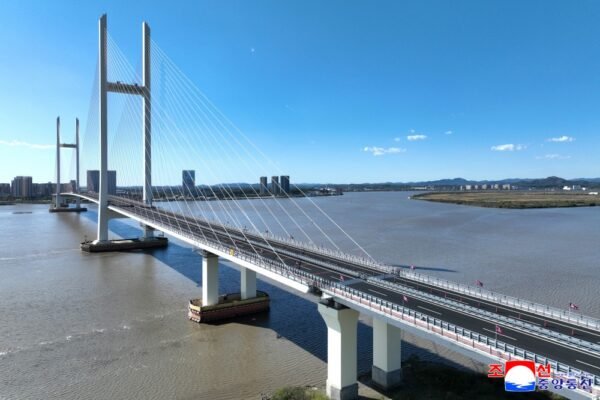
The New Yalu River Bridge, which hyperlinks Dandong in China’s Liaoning province with Sinuiju in North Pyongan province, has lastly opened, a full 12 years after building completed in 2014. The 2 international locations held a gap ceremony on October 15 and started working cargo vehicles throughout the bridge, which is named the Amnok River bridge in North Korea.
For years the bridge symbolized China-North Korea financial cooperation and in addition the sensible limits on how far that cooperation may really go. Now it’s lastly doing the job it was constructed for.
The 2 international locations agreed to construct the bridge in 2009, and building started the next yr. It was a significant venture meant to get previous the logistical limits of the present Sino-Korean Friendship Bridge. A four-lane bridge greater than 3 kilometers (1.9 miles) lengthy may vastly increase the circulate of products between Dandong and Sinuiju. China was prepared to pay for building to open a brand new channel for financial cooperation with the North.
Fifteen years in the past, I used to be reporting for Day by day NK in China. Again then, Dandong was stuffed with anticipation concerning the bridge. Individuals all over the place mentioned a brand new crossing would convey a surge in China-North Korea commerce, and {that a} new financial zone would develop up round Sinuiju and Dandong. Chinese language businesspeople anticipated commerce with the North to increase, and property costs close to the deliberate growth areas started to climb.
In August 2011, Day by day NK reported that work on a pontoon bridge for the development was 70 p.c full and that close by actual property costs have been rising. Some in Dandong even speculated that the bridge may lead North Korea to open its financial system extra broadly. I nonetheless keep in mind that temper clearly from my time on the bottom.
Actuality fell wanting these hopes. The bridge was completed in 2014, however the North Korean facet by no means correctly constructed the connecting roads or customs amenities. Ups and downs in bilateral relations, worldwide sanctions, and the COVID-19 border closure adopted, and the bridge stayed shut for years. It was a protracted look forward to the Chinese language businesspeople who had hoped for brand spanking new alternatives, and for everybody who had anticipated commerce with the North to develop.
North Korea’s insularity alone doesn’t clarify the delay. The 2 international locations’ financial pursuits, the political local weather, sanctions, and different elements all performed an element. What is obvious, although, is that North Korean authorities took a protracted and cautious method to how a lot financial contact with the skin world they’d permit, and the way they’d handle it.
Ultimately, the exhausting half was not constructing the bridge. It was getting previous the North Korean authorities’ extraordinarily slim threshold. Pyongyang wished the financial advantages, nevertheless it by no means let down its guard towards the modifications outdoors contact may convey. The 12 years the bridge sat successfully unused lay naked this contradiction on the coronary heart of the North Korean financial system.
Extra Commerce Means New Alternatives and New Assessments
So now that the bridge is open, will North Korea’s financial system change? Within the brief time period, we are able to count on extra commerce and extra environment friendly transport between the 2 international locations. Freight that used to pile onto the Sino-Korean Friendship Bridge can now be unfold out, and there’s lastly a route that may reliably carry bigger volumes of products.
Nonetheless, it could be a mistake to imagine the opening will shortly produce a leap in commerce or higher lives for atypical North Koreans. How a lot really strikes will rely upon customs procedures, transport prices, commerce permits, and the way items are distributed inside North Korea. A wider bridge doesn’t essentially imply North Korea’s financial system has opened any wider.
The larger story could also be how distribution inside North Korea modifications. Markets are nonetheless central to how atypical North Koreans make a residing. Recently, nonetheless, the authorities haven’t merely been suppressing the overall markets. They’ve been utilizing state-run shops, state grain retailers, and different stores to increase state management over distribution and gross sales.
Underneath these situations, if extra imports circulate throughout the bridge, state-approved buying and selling corporations and distribution businesses are more likely to profit first. Previously, personal retailers introduced in imported items by varied channels and equipped them to markets. That mannequin might give method additional to 1 the place the state manages the import and allocation of products, with markets and stores working beneath it.
Non-public retailers may nonetheless discover new openings. Extra secure logistics and a bigger provide of Chinese language shopper items and uncooked supplies may imply extra selection for buyers and steadier costs for some objects. If factories and enterprises can supply uncooked supplies extra simply, manufacturing may gain advantage too.
But when the state tightens its grip on imports and distribution, the beneficial properties may focus within the businesses that maintain commerce permits and the facility to allocate items. Non-public retailers would grow to be extra depending on state-designated distribution channels, and the assorted prices and casual funds they face may nicely rise.
How the bridge ties into North Korea’s “20×10” regional growth coverage can be price watching. The North is racing to construct native industrial factories, however placing up a constructing is one factor and working a manufacturing unit is one other. What issues shouldn’t be what number of factories have been constructed. It’s what number of days a month they really run, the place their uncooked supplies come from, and what costs residents pay for what they produce. With no regular provide of uncooked supplies, electrical energy, and manufacturing tools, these factories will battle to function.
Right here, extra Chinese language uncooked supplies and provides may enhance working situations at some native factories. But the extra these factories depend on Chinese language inputs, the additional they drift from the self-reliant native financial system the authorities preserve selling.
Growth round Sinuiju additionally deserves consideration. In accordance with a current Day by day NK investigation, North Korea has reportedly pitched Chinese language businesspeople on a plan to develop the world behind the bridge and a few 40 sq. kilometers (15 sq. miles) of southern Sinuiju into an financial hub for logistics, processing, commerce, and commerce. This implies Pyongyang needs to make use of the bridge’s opening to make extra financial use of the border area.
We should always nonetheless separate growth plans from precise funding and manufacturing. Present United Nations sanctions sharply prohibit imports of business tools, exports of North Korean processed items, and joint ventures. Early on, the advantages will possible be restricted to higher customs and logistics, with any large-scale industrial cooperation shifting slowly.
Above all, North Korea’s financial system may grow to be much more depending on China. Deeper reliance on Chinese language uncooked supplies, shopper items, capital, and logistics networks may give the financial system a short-term raise. It may additionally go away the financial system extra uncovered to shifts in Chinese language coverage and commerce situations. The hole between the self-reliance the regime preaches and its actual dependence on China may develop wider.
In the end, the bridge’s opening is each a chance and a significant check for North Korea’s financial system. The query is what the authorities do with the additional items and financial openings. Will they let atypical individuals increase their financial exercise, or will the state tighten its maintain on income and distribution channels? The reply appears set to form the construction of North Korea’s financial system within the years forward.
The Actual Measure Is How Individuals Reside
The variety of vehicles crossing the bridge shouldn’t be the one factor to look at. Precise freight volumes, the products being traded, customs procedures, and delivery prices all matter. However to essentially decide how North Korea’s financial system is altering, we have to comply with the place these items go, who controls the commerce, and the way it finally impacts individuals’s every day lives.
Which means monitoring particular financial indicators over time. What number of vehicles cross the bridge every month? How a lot does the share of Chinese language items in markets change? How are individuals’s purchases cut up between state-run shops and the overall markets, and the way is that altering?
We additionally want to have a look at what number of days native factories with extra Chinese language inputs really run and the way a lot they produce, and the way extra imports have an effect on shopper costs and folks’s buying energy.
With these questions in thoughts, the Day by day NK sees a must preserve monitoring modifications in North Korea’s financial construction and in individuals’s residing situations. Evaluating tendencies at three months, six months, and one yr after the opening ought to give a clearer image of how the financial system is basically altering.
What issues right here is the route of change, not whether or not a single quantity rises or falls. If imports go up however buying energy doesn’t enhance, we have to discover out why. If state shops see extra clients, we have to know whether or not personal market commerce is shrinking or whether or not each are rising. Extra items coming in and folks discovering it simpler to purchase issues are two very totally different issues.
Specifically, evaluating financial situations in main cities similar to Sinuiju (North Pyongan province), Pyongsong (South Pyongan province), and Hyesan (Ryanggang province) can present whether or not extra border commerce is reaching individuals inland and within the provinces. Even when imports develop on the border, distribution prices and native provide situations imply residents in several areas might really feel the change very in a different way.
We additionally must see whether or not growth in Sinuiju really creates jobs and raises incomes. New amenities, roads, and housing are exhausting to rely as a hit if residents are hit with calls for for cash or pressured labor mobilizations alongside the best way. Past how the event appears, we have to see who bears the prices and who reaps the advantages.
Sanctions enforcement additionally stays an necessary difficulty. Expanded commerce in reliable items for atypical individuals have to be clearly distinguished from transfers of sanctioned objects. We have to verify whether or not wider financial cooperation turns into a channel for evading sanctions. On the similar time, we have to look carefully at how a lot reliable commerce and financial exercise, the type wanted to enhance individuals’s lives, is definitely occurring.
The individuals I met in Dandong 15 years in the past anticipated North Korea to vary as soon as the brand new bridge was constructed. As a substitute, the completed bridge stayed closed for 12 years. Issues are clearly totally different now. North Korea wants extra commerce and sensible financial beneficial properties, and China needs to increase its affect by financial cooperation with the North.
Even so, we shouldn’t merely repeat the hopes of that point. Expanded China-North Korea financial ties is not going to routinely imply freer markets or extra freedom for individuals to make a residing. North Korea has a historical past of chasing financial beneficial properties whereas tightening management over markets and atypical individuals’s financial exercise.
The New Yalu River Bridge is lastly open. However the true check of change in North Korea’s financial system received’t be the vehicles crossing it. It will likely be what North Korean society does with the products they carry.
We now must look extra carefully at what is going on on the North Korean facet of the bridge: how state management is shifting, how the markets are adapting, and whether or not individuals’s lives are getting even just a little higher. What issues greater than the bridge opening is how far the modifications it brings really attain atypical North Koreans. That’s the place our view of the New Yalu River Bridge, open after 12 years, ought to start.