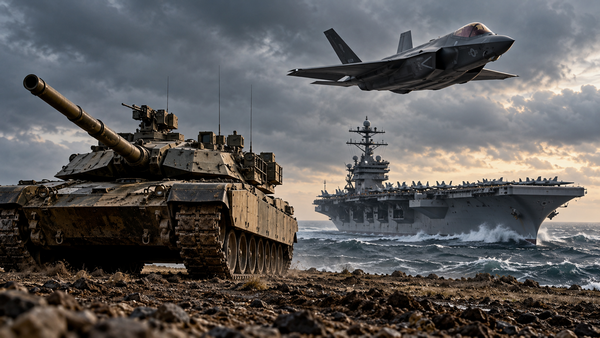
A fetish is an object invested with powers or significance past its precise properties. In its authentic anthropological sense, the time period describes an object believed to own supernatural powers. Extra typically, fetishism happens when the worth attributed to an object turns into indifferent from its utility. The thing acquires a significance impartial of what it truly accomplishes.
Navy establishments are notably vulnerable to this distortion. Weapons are developed to serve operational and strategic targets, however profitable weapons purchase reputations that transcend their sensible effectiveness. The battleship grew to become an emblem of naval supremacy, the tank an embodiment of battlefield dominance, and the fighter plane an expression of technological superiority and martial prowess. Their status turns into embedded in army traditions, skilled identities, and nationwide tradition.
Enduring icons of U.S. army energy: tanks, fight plane, and plane carriers
Weapons fetishism happens when the perceived worth of a weapon turns into indifferent from its demonstrated utility and is handled as an inherent property of the weapon itself. But army effectiveness just isn’t an intrinsic property. It is determined by the operational surroundings, adversary capabilities, obtainable options, and the targets army drive is meant to realize. A weapon that after conferred decisive benefits might turn out to be progressively much less helpful as these circumstances change. Technological sophistication and damaging energy don’t essentially translate into strategic effectiveness.
Perceptions of army utility don’t robotically regulate to altering realities. Weapons purchase reputations via demonstrated achievements or the promise of future capabilities, whereas army organizations develop doctrines, skilled communities, procurement applications, and industrial relationships round them. Cultural, reputational, and institutional inertia can maintain funding in established weapons whilst their relative effectiveness declines. Their preservation might turn out to be an institutional goal in its personal proper.
This course of needn’t contain irrational enthusiasm or deliberate deception. Navy professionals might sincerely consider within the persevering with worth of acquainted weapons, whereas organizations search to guard investments and experience collected over a long time. The distortion arises when these commitments impede reassessment of army effectiveness underneath altering circumstances.
Neither is weapons fetishism confined to established armaments. New weapons can purchase exaggerated reputations via the promise of capabilities they’ve but to reveal. An interesting technological aspiration might generate substantial institutional commitments earlier than its operational effectiveness or strategic utility has been established.
The underlying error is similar in each instances: the instrument of warfare is elevated above the needs it’s imagined to serve. This text examines how weapons fetishism develops, why it persists, and the way it distorts up to date American army priorities in what has come to resemble a cult of weaponry.
The Recurring Cycle of Weapons Fetishism
Navy historical past is punctuated by dramatic reversals wherein established weapons and strategies of warfare proved insufficient towards altering applied sciences and ways. Weapons that after conferred army superiority can retain their reputations even because the circumstances liable for their effectiveness disappear. The ensuing divergence between perceived and demonstrated utility is commonly uncovered via expensive battlefield expertise.
On the Battle of Crécy in 1346, French armored knights, representing the status and putting energy of medieval mounted warfare, suffered a devastating defeat towards an English military using longbowmen, dismounted men-at-arms, and advantageous defensive positions. The battle didn’t render armored cavalry out of date, nevertheless it demonstrated that its conventional superiority may not be assumed underneath all battlefield circumstances. Navy status had outrun tactical effectiveness.
The Ottoman conquest of Constantinople in 1453 demonstrated one other transformation. The huge partitions of the Byzantine capital had resisted repeated sieges for hundreds of years, sustaining their fame as practically impregnable fortifications. Ottoman heavy artillery helped breach these defenses, revealing the rising vulnerability of medieval masonry to gunpowder weapons. Fortifications remained important to warfare, however their design and development must adapt.
The industrialization of warfare produced an much more damaging confrontation between inherited expectations and army actuality. On the Battle of the Somme in 1916, British infantry superior towards German defenses protected by machine weapons, artillery, barbed wire, and fortified positions. The British Military suffered roughly 57,000 casualties on the primary day alone. The disaster demonstrated the problem of conducting offensive operations towards industrialized defensive firepower, undermining expectations that decided infantry assaults may obtain decisive breakthroughs.
The Second World Struggle supplied a comparable transformation at sea. Battleships had lengthy embodied naval energy, their huge weapons and armor representing the end result of centuries of floor warfare. But carrier-based plane demonstrated the power to destroy capital ships at distances far past the attain of naval artillery. The British assault on the Italian fleet at Taranto in 1940, the Japanese assault on Pearl Harbor in 1941, and the decisive function of service aviation at Halfway in 1942 established the rising primacy of naval aviation. Battleships didn’t disappear instantly, however their place because the principal devices of naval supremacy was decisively ended.
These episodes illustrate a recurring cycle. New weapons and ways set up their effectiveness and purchase status, encouraging army establishments to prepare doctrines, skilled communities, and procurement priorities round them. Subsequent technological developments alter the circumstances of warfare, diminishing the relative utility of established weapons. Their collected reputations and institutional commitments impede adaptation till army reversals compel reassessment. The profitable replacements then purchase their very own status, creating the circumstances for an additional cycle.
Traditionally, battlefield expertise incessantly provided the corrective proof wanted to beat entrenched army assumptions. Fashionable army establishments possess analytical strategies that ought to allow them to anticipate such reversals with out struggling catastrophic defeats. Nonetheless, the persistence of weapons fetishism demonstrates the problem of translating altering army realities into institutional adaptation.
The Three Mechanisms of Weapons Fetishism
The persistence of established weapons regardless of proof of declining utility outcomes from three mutually reinforcing forces: cultural, reputational, and institutional inertia. Every operates via a unique mechanism, however collectively they’ll maintain weapons applications lengthy after their strategic justification has weakened.
Cultural inertia arises from the symbolic significance that weapons purchase inside army organizations and the societies they serve. Weapons turn out to be embodiments of nationwide energy, technological achievement, and martial advantage. The battleship symbolizes command of the seas, the tank represents armored may, and the fighter plane evokes the heroic picture of the person warrior. These associations are strengthened via army traditions, standard leisure, and historic narratives.
The project of extraordinary energy to a weapon has deep historic and behavioral roots. It’s a type of cognitive compression that reduces the complicated causes of army victory to the supposedly extraordinary energy of a single weapon, typically a magical sword.
Navy skilled identities are particularly vulnerable to such attachments. Fighter pilots, naval aviators, submariners, and armored warfare specialists belong to communities whose status and traditions are intently related to specific weapons and strategies of fight. Their dedication to mastering these devices is comprehensible, however it will probably foster resistance to applied sciences or operational ideas that diminish the significance of established specialties. The displacement of a weapon might threaten not solely an operational functionality but in addition an expert identification.
Reputational inertia issues the persistence of beliefs a few weapon’s effectiveness. Weapons purchase reputations via demonstrated achievements or expectations of future capabilities. Each sources can generate confidence that turns into embedded in army doctrine, procurement planning, and expectations of future efficiency. But operational circumstances might change, and anticipated capabilities might show tough or unattainable to comprehend. Enhancements in technical efficiency can reinforce confidence in a weapon with out demonstrating that it stays the best technique of carrying out its mission. Over time, its fame might turn out to be more and more indifferent from operational actuality.
The battle in Ukraine has repeatedly demonstrated the constraints of supposedly game-changing weapons. Javelin antitank missiles, HIMARS rocket artillery, Excalibur precision-guided shells, superior Western tanks, and F-16 fighters have all been heralded as probably transformative. Some achieved substantial tactical successes, however none independently produced a decisive strategic breakthrough. Russian countermeasures, digital warfare, battlefield adaptation, and the persistent calls for of logistics and drive focus have constrained their effectiveness. But the status of those superior weapons has typically survived the frustration of expectations, with shortcomings attributed to insufficient numbers or supporting capabilities. Though such explanations could also be justified, they’ll additionally protect confidence in a weapon with out adequately reassessing its strategic utility.
The recurring perception {that a} superior weapon can remodel the end result of a fancy army wrestle recollects the traditional religion in magical swords. Navy success is determined by interacting programs and circumstances, not the supposedly transcendent qualities of particular person weapons.
Reputational inertia just isn’t confined to weapons with distinguished data of battlefield success. Aspirational expectations can generate confidence and status earlier than a proposed expertise has demonstrated its operational effectiveness. As soon as institutionalized, these expectations might persist regardless of disappointing outcomes. Strategic missile protection supplies a revealing instance.
Institutional inertia arises from the organizational and financial constructions constructed round established weapons. Main applications assist networks of army instructions, analysis institutions, protection contractors, congressional constituencies, coaching services, and upkeep organizations. Navy careers, organizational budgets, industrial investments, and political pursuits turn out to be depending on their continuation, making termination tough even when superior options emerge.
Institutional inertia is especially proof against correction as a result of it doesn’t require continued confidence in a weapon’s superiority. Organizations might acknowledge deficiencies whereas opposing substitute as a result of the transition threatens budgets, employment, authority, or collected investments. The argument that an excessive amount of has already been invested to desert a program can remodel unrecoverable expenditures right into a justification for additional commitments.
The three types of inertia reinforce each other. Cultural status legitimizes continued funding, reputational confidence sustains expectations of effectiveness, and institutional commitments present the sources and political affect wanted to perpetuate weapons applications. Conversely, continued funding reinforces a weapon’s cultural significance and obvious credibility. The dimensions of institutional dedication might itself be interpreted as proof of indispensability.
These forces additionally form the analysis of options. Navy organizations typically assess new applied sciences via necessities and operational ideas derived from current drive constructions. An unmanned plane could also be judged towards the capabilities of a crewed fighter reasonably than evaluated as a part of a essentially totally different system of warfare. Equally, distributed naval forces could also be measured towards the concentrated putting energy of an plane service reasonably than assessed for his or her capability to realize strategic targets via totally different operational strategies.
Established weapons thus turn out to be the requirements towards which their potential replacements are judged, even when innovation ought to contain reconsidering the requirements themselves. Technological growth could also be directed towards preserving acquainted capabilities reasonably than exploring more practical options.
Weapons fetishism due to this fact emerges not from a single irrational desire however from the interplay of beliefs, reputations, and organizational pursuits. Its up to date manifestations are notably seen within the continued growth of tanks, crewed fight plane, main floor warships, and strategic missile protection programs.
The Essential Battle Tank
The principle battle tank has occupied a central place in trendy land warfare since World Struggle II. Combining mobility, armor safety, and heavy firepower, tanks grew to become principal devices of mechanized offensive operations. Their battlefield achievements established an everlasting fame for decisive fight energy, strengthened by the status of armored formations and the institutional affect of their commanders.
The tank’s historic benefits trusted its capability to pay attention protected firepower at decisive factors. Armored formations may penetrate defensive positions and exploit breakthroughs with extraordinary pace. Even towards well-equipped adversaries, tanks supplied a mixture of tactical mobility, direct firepower, and survivability that different floor fight programs couldn’t readily match.
The proliferation of precision-guided antitank weapons started to erode these benefits. Comparatively cheap guided missiles enabled infantry to destroy armored automobiles at appreciable distances, whereas top-attack munitions exploited vulnerabilities in comparatively skinny roof armor. These developments elevated the price and complexity of tank safety with out eliminating their publicity to assault.
The battle in Ukraine has accelerated this transformation. Persistent aerial surveillance, reconnaissance and assault drones, precision artillery, and in depth minefields have made concentrated armored maneuver more and more hazardous. First-person-view drones have launched comparatively cheap weapons able to damaging or destroying automobiles costing thousands and thousands of {dollars}. Extra importantly, pervasive surveillance and precision assault threaten the meeting, motion, provide, and coordination of armored formations. A tank might survive an assault but turn out to be immobilized, remoted, or unable to function successfully with out in depth supporting measures.
Navy organizations have responded with further armor, digital countermeasures, lively safety programs, improvised anti-drone constructions, and revised ways. These variations can enhance survivability, however in addition they improve price, complexity, and logistical calls for. The progressive accumulation of protecting gear raises a basic query: how a lot further funding is justified to protect the battlefield utility of a weapon whose working surroundings has turn out to be more and more hostile?
None of this establishes that tanks have turn out to be ineffective. They maintain beneficial capabilities for direct fireplace assist, protected motion, and operations towards fortified positions. Their continued employment in Ukraine demonstrates that armored automobiles nonetheless fulfill vital battlefield features, though their effectiveness relies upon closely on supporting forces, terrain, and tactical circumstances.
The problem is due to this fact not whether or not tanks retain some utility, however whether or not their historic fame continues to justify their privileged place in drive constructions and procurement priorities. A weapon can stay helpful whereas changing into much less cost-effective than rising options for specific missions. Cultural attachment to armored energy, institutional commitments to mechanized formations, and confidence derived from historic achievements can impede recognition of this altering relationship. The hazard just isn’t essentially the continued procurement of tanks, however the assumption that their conventional battlefield significance establishes their future indispensability.
Manned Fight Plane
Navy aviation supplies a revealing instance of the interplay between cultural status and institutional inertia. The fight pilot occupies a celebrated place in army historical past and standard tradition, embodying particular person ability, braveness, and technological mastery. Fighter pilots particularly have acquired an virtually mythological standing, strengthened by army traditions and standard portrayals of aerial fight.
But the technological foundations of army aviation have modified profoundly. Fashionable plane depend upon computerized flight controls, refined sensors, automated navigation, and more and more autonomous mission programs. Unmanned plane have demonstrated the power to conduct surveillance, reconnaissance, and precision strikes with out exposing flight crews to enemy motion. Advances in computing, communications, and synthetic intelligence are increasing the vary of missions that may be carried out with out onboard pilots. The rising significance of beyond-visual-range missile fight has additionally decreased the centrality of conventional dogfighting abilities.
The Navy’s expertise with unmanned service aviation is instructive. The Northrop Grumman X-47B demonstrated autonomous service takeoffs and landings, aerial refueling, and different capabilities important to working unmanned plane from plane carriers. These achievements instructed the potential for extending service aviation into missions beforehand reserved for crewed plane, together with long-range strikes in closely defended environments.
Nonetheless, the Navy’s subsequent carrier-based unmanned plane program emphasised aerial refueling reasonably than penetrating strike. The ensuing MQ-25 Stingray was designed primarily to increase the operational vary of crewed service plane. This choice mirrored reputable operational priorities, nevertheless it additionally preserved the centrality of manned fight aviation. Somewhat than growing an unmanned plane to exchange current strike platforms, the Navy chosen a mission that might improve their effectiveness.
An unmanned strike plane may probably exploit design freedoms unavailable to crewed plane. Eliminating the cockpit, life-support programs, ejection gear, and related security necessities permits various configurations and advantageous tradeoffs in weight, quantity, endurance, and payload. Plane with out onboard pilots also can undertake missions involving personnel dangers that may be unacceptable for crewed platforms.
The Air Drive’s continued funding in manned strategic bombers raises associated questions. The B-21 Raider incorporates superior stealth expertise and is meant to penetrate refined air defenses, but retains an onboard crew. Strategic bombing missions typically don’t require the fast maneuvering related to fighter fight, whereas flight management, navigation, mission planning, and weapons employment already rely extensively on computerized programs. Retaining a crew imposes necessities for cockpit house, environmental management, life assist, crew safety, and emergency programs, whereas exposing extremely skilled personnel to the hazards of defended airspace.
There are reputable causes for retaining human crews, together with communications resilience, mission flexibility, authorization of weapons employment, and responses to unexpected circumstances. Significantly in nuclear operations, command authority and optimistic management are indispensable. These issues should be weighed towards the potential benefits of unmanned options reasonably than handled as establishing the everlasting necessity of onboard crews.
The related query is whether or not crewed plane stay the best technique of carrying out specific missions, contemplating their full life-cycle prices, operational dangers, and obtainable options. Comparisons confined to particular person plane efficiency might obscure the benefits of distributed unmanned programs, together with better numbers, probably decrease unit prices, and the power to simply accept greater attrition.
Manned fight aviation illustrates how skilled identities and organizational commitments can form technological growth. The status of the fight pilot reinforces the cultural legitimacy of crewed plane, whereas establishments organized round pilot coaching, profession development, and established procurement applications have highly effective incentives to protect their central function.
The problem is to not get rid of human judgment from army operations, however to find out the place that judgment should be exercised. The continued presence of a human decision-maker needn’t suggest the continued presence of a human occupant in each fight plane.
Plane Carriers and Main Floor Combatants
The plane service occupies a place in trendy naval warfare akin to that after held by the battleship. Its huge dimension, technological sophistication, and capability to mission army energy make it an imposing image of nationwide energy. The USA has organized a lot of its naval forces round service strike teams, treating these formations as indispensable devices of maritime dominance and world army intervention.
The service’s fame rests on substantial historic achievements. Throughout World Struggle II, naval aviation displaced battleships because the principal putting arm of main fleets. In subsequent a long time, American carriers supplied cellular air bases for operations in Korea, Vietnam, Iraq, Afghanistan, and quite a few smaller conflicts. Their capability to ship sustained airpower with out relying fully on international airfields made them exceptionally beneficial devices of army coverage.
But the circumstances liable for these successes have modified. American carriers have typically operated towards adversaries possessing restricted capability to find and assault them at sea. Confrontation with a technologically refined naval energy presents a unique downside. Lengthy-range antiship missiles, succesful submarines, persistent surveillance programs, and unmanned reconnaissance and assault platforms threaten the liberty of maneuver on which service operations rely.
China’s growth of intensive anti-access and area-denial capabilities illustrates this transformation. Land-based ballistic and cruise missiles, supported by satellites, plane, ships, and different sensors, create overlapping threats to floor forces working inside vary of the Chinese language mainland. Though detecting, monitoring, and efficiently attacking a maneuvering service stays a demanding operational problem, long-range precision weapons have made the survivability of concentrated naval formations more and more unsure.
The service’s focus of army worth compounds this downside. A nuclear-powered supercarrier represents an funding of many billions of {dollars}, carries hundreds of personnel, and helps an air wing of refined plane. Its loss or critical disablement would represent a unprecedented army and political setback. Commanders might consequently be compelled to function carriers at better distances from hostile territory, decreasing the effectiveness of their embarked plane.
This creates a strategic paradox. The better the worth attributed to the service, the extra reluctant commanders might turn out to be to reveal it to hazard. A weapon designed to mission army energy can turn out to be so beneficial that its preservation constrains its employment. The specter of long-range antiship weapons can due to this fact diminish a service’s operational contribution even with out an enemy efficiently attacking it.
The Navy has responded with longer-range plane, improved defenses, distributed maritime operations, and new unmanned capabilities. But these measures typically protect the service strike group as a centerpiece of American naval energy. The query is whether or not incremental enhancements can adequately compensate for the altering relationship between concentrated floor forces and more and more dispersed programs of surveillance and assault.
The dilemma extends to main floor combatants. Fashionable destroyers and cruisers possess succesful radar programs, refined fight administration gear, and substantial missile batteries. Nonetheless, their effectiveness is determined by finite missile inventories, weak sensors, and the power to resist coordinated assaults involving a number of forms of weapons. Comparatively cheap unmanned plane and floor vessels can impose substantial defensive burdens on warships geared up with expensive interceptors. Repeated assaults might exhaust defensive magazines or compel withdrawal for replenishment, even when particular person assaults are defeated.
These developments recommend options to concentrating naval energy in a restricted variety of exceptionally succesful platforms. Distributed networks of unmanned floor vessels, underwater automobiles, autonomous sensors, and remotely operated weapons may present persistent surveillance and offensive capabilities throughout in depth maritime areas. Such programs would disperse army worth, complicate enemy focusing on, and cut back dependence on the survival of particular person capital ships. Their operational effectiveness, nonetheless, should be demonstrated reasonably than presumed.
Naval warfare is very vulnerable to weapons fetishism as a result of its principal platforms mix cultural status, historic fame, and immense institutional funding. The query just isn’t whether or not plane carriers and main floor combatants retain army utility, however whether or not their collected status and institutional significance have turn out to be disproportionate to their potential contribution to naval warfare. The displacement of the battleship by the plane service demonstrates that even essentially the most formidable devices of maritime energy can lose their primacy. There isn’t a cause to imagine that the historic cycle has ended with the current era of capital ships.
Strategic Missile Protection
Strategic missile protection illustrates a unique manifestation of weapons fetishism. In contrast to tanks, fight plane, and capital ships, whose reputations derive from historic achievements, complete missile protection has acquired status primarily via the promise of a functionality it has but to reveal. The aspiration to guard a nation towards nuclear assault is so compelling that the desirability of the target can turn out to be confused with its feasibility and strategic utility.
This confusion is clear in President Trump’s Golden Dome initiative, which drew inspiration from Israel’s Iron Dome protection system. Iron Dome has demonstrated substantial effectiveness towards short-range rockets, however defending the continental United States towards refined intercontinental ballistic missiles presents a essentially totally different technical and operational problem. Profitable interception of particular person missiles underneath specific circumstances doesn’t set up the feasibility of a complete nationwide protect.
Israel’s expertise defending towards Iranian ballistic missiles illustrates the constraints of this extrapolation. Regardless of refined multilayered defenses, Iranian missiles penetrated and struck Israeli territory in the course of the June 2025 battle. Interception efficiency thought of extremely profitable towards typical assaults might be catastrophically insufficient towards nuclear weapons. Even a protection able to intercepting 99 p.c of an incoming salvo of 100 nuclear warheads would allow a mean of 1 warhead to penetrate, probably enough to destroy a serious metropolis.
Furthermore, missile protection can’t be evaluated via interception efficiency alone. A protect perceived as threatening an adversary’s retaliatory functionality might encourage offensive enlargement, countermeasures, or preemptive motion. The pursuit of better safety may due to this fact stimulate developments that diminish nationwide safety.
Strategic missile protection exemplifies potential weapons fetishism, wherein technological promise acquires institutional momentum earlier than strategic utility has been established. The aspiration to realize nationwide invulnerability can maintain huge investments even when technical achievements fall far in need of demonstrating that the final word goal is attainable or strategically useful.
The underlying error is the substitution of technological promise for demonstrated strategic effectiveness. A weapon needn’t possess a distinguished report of army success to turn out to be an object of fetishistic attachment. The promise of future success could also be enough.
The Penalties of Weapons Fetishism
The results of weapons fetishism prolong past the procurement of high-priced or more and more ineffective armaments. The elemental downside is the distortion of army priorities. When established weapons purchase significance impartial of their demonstrated utility, preserving and enhancing current capabilities can displace the seek for more practical technique of reaching strategic targets.
Probably the most quick consequence is the misallocation of sources. Fashionable weapons applications require huge investments in growth, manufacturing, personnel, infrastructure, and upkeep. These commitments can prolong over a long time, whilst altering circumstances undermine their justification. The F-35 fighter program, for instance, is projected to price greater than $2 trillion in acquisition and sustainment expenditures over its lifetime, in response to the U.S. Authorities Accountability Workplace.
The proposed Golden Dome missile protection system would additionally require extraordinary expenditures due to the demanding requirement for near-perfect interception and the need of elaborate orbital elements. Even a 99 p.c interception fee may allow catastrophic destruction in a nuclear assault, creating stress for extra defensive layers, sensors, and interceptors. In Could 2026, the Congressional Funds Workplace estimated {that a} nationwide missile protection structure broadly in step with Golden Dome’s said targets would price roughly $1.2 trillion over 20 years. This illustrative system was not designed to defeat a large-scale nuclear assault by a serious energy, and its estimated price just isn’t a projection of the particular Golden Dome program. The pursuit of nationwide invulnerability thus creates a probably open-ended monetary dedication, with no inherent restrict to the expenditures that may be justified in pursuit of an unattainable customary of safety.
The chance prices are equally consequential. Assets dedicated to established applications are unavailable for options. Continued funding in costly crewed plane might constrain growth of unmanned programs. Capital ship development can restrict sources obtainable for distributed naval forces, whereas investments in closely armored automobiles compete with reconnaissance, digital warfare, and unmanned weapons. The related comparability just isn’t between a longtime weapon and its absence, however between various technique of carrying out the identical army targets.
The escalating price of superior weapons creates one other strategic downside: the tradeoff between technological sophistication and drive dimension. As particular person weapons turn out to be extra elaborate and costly, procurement budgets assist fewer models, decreasing the numerical energy, geographic protection, and attrition tolerance of army forces. The distinction with World Struggle II is putting. Fashionable fighters, tanks, warships, and bombers provide capabilities far exceeding these of their predecessors, however their a lot greater unit prices constrain the portions that may be produced and changed. Superior efficiency by particular person weapons doesn’t essentially compensate for decreased numbers, notably in extended conflicts the place losses should be changed and army operations sustained. The next desk illustrates the large development in weapon prices and the corresponding variations in manufacturing scale.
Weapons fetishism also can distort the construction of army forces. Organizations constructed round established platforms are inclined to formulate necessities that protect their centrality. New applied sciences are included as dietary supplements reasonably than evaluated as potential replacements. The outcome could also be a technologically refined drive whose group displays more and more outdated assumptions about warfare.
These distortions turn out to be notably harmful when weapons reputations encourage exaggerated expectations of army effectiveness. A drive that seems formidable in firepower, technological sophistication, or mixture expenditure might show poorly tailored to precise fight circumstances. The discrepancy between anticipated and demonstrated efficiency can produce operational failures, strategic miscalculations, and pressures for escalation.
The nuclear period magnifies these risks. Traditionally, battlefield reversals compelled army establishments to desert outdated assumptions and undertake more practical weapons. Though the human prices might be appalling, defeated societies typically survived to be taught from their errors. Confrontation between nuclear-armed powers provides no assurance of such a possibility. Miscalculations regarding army capabilities or the feasibility of reaching decisive benefits may provoke escalation whose penalties would overwhelm any conceivable advantages of victory.
Weapons fetishism is due to this fact greater than an costly type of institutional conservatism. It might probably undermine nationwide safety by diverting sources, delaying adaptation, exaggerating confidence in army capabilities, and inspiring strategic choices primarily based on mistaken assessments of effectiveness. A nation might possess more and more refined and costly weapons whereas changing into much less able to reaching its strategic targets—and extra weak to the implications of making an attempt to make use of them.
Breaking the Weapons Fetish Cycle
Breaking the cycle of weapons fetishism requires greater than changing out of date weapons with newer applied sciences. Profitable improvements can themselves turn out to be objects of exaggerated status and institutional attachment. Unmanned plane, autonomous warships, and synthetic intelligence are not any extra inherently beneficial than the weapons they might displace. Their utility should be demonstrated, not assumed from their technological novelty.
The elemental treatment is to subordinate weapons growth to a hierarchy of strategic targets, operational necessities, and comparative analysis of options. Somewhat than starting with a longtime weapons class and searching for enhancements in its capabilities, army planners ought to ask what mixture of capabilities can most successfully accomplish a specified mission. The reply might contain enhancing an current weapon, adopting a unique expertise, reorganizing forces, or abandoning a mission whose contribution to nationwide safety not justifies its prices and dangers.
Such evaluations should prolong past technical efficiency to embody survivability, logistical necessities, manufacturing capability, working prices, vulnerability to countermeasures, and adversarial adaptation. Strategic utility calls for a broader evaluation of penalties for deterrence, escalation, and worldwide safety. Technical superiority just isn’t enough if the ensuing army posture undermines the targets it’s meant to serve.
Steady reassessment is important as a result of weapons applications prolong over durations throughout which the character of warfare might change considerably. Impartial analysis, real looking operational testing, comparative evaluation, and specific consideration of alternative prices ought to accompany applications all through their growth and repair lives. Proof of declining relative utility should be allowed to problem established commitments reasonably than merely stimulate one other spherical of expensive modifications.
Institutional reform should additionally handle the incentives that perpetuate weapons applications. Navy organizations ought to be rewarded for figuring out superior options and adapting to altering circumstances, not merely for preserving established capabilities. Terminating an outdated program ought to be acknowledged as a probably beneficial strategic choice reasonably than an institutional defeat. Mental independence and willingness to problem skilled orthodoxies are as vital to army effectiveness as technical experience.
The historic cycle of weapons fetishism can’t be eradicated fully. Navy establishments will all the time depend upon collected expertise and judgments made underneath uncertainty. Nonetheless, the true measure of army progress just isn’t the perceived impressiveness of weapons, however their demonstrated efficacy. Breaking the cycle requires the mental braveness to desert acquainted devices of warfare when their continued preservation not serves their meant goal: nationwide protection.