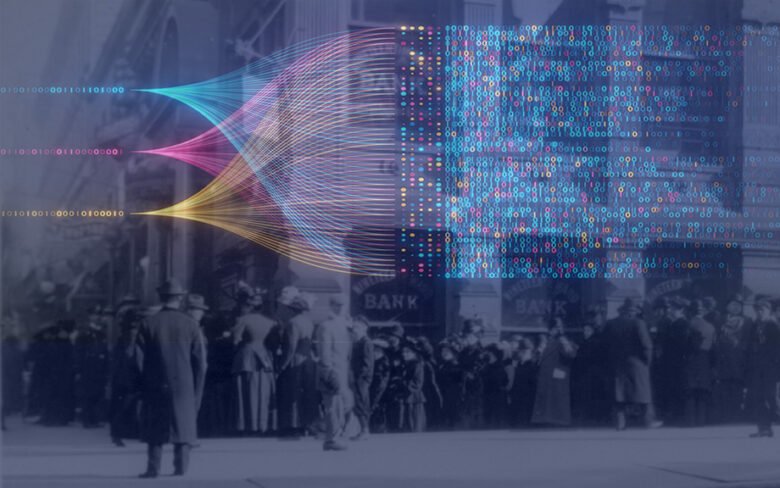
Banking crises are generally related to financial institution runs and banking panics, but our empirical understanding of financial institution runs is constrained by a scarcity of bank-level information. In a brand new paper, we use giant language fashions (LLMs) to extract info on financial institution runs from thousands and thousands of digitized historic newspaper pages, creating probably the most complete database of financial institution runs in U.S. historical past. Each financial institution run episode that we establish is documented on a companion web site the place customers can browse and look at particular person episodes, and browse the unique newspaper articles. On this submit, we describe how we constructed this dataset and focus on what its primary options reveal.
Creator Transient
We used giant language fashions to create probably the most complete database of financial institution runs in U.S. historical past.
— Stephan Luck, coauthor
How Newspapers Can Assist Us to Perceive Financial institution Runs
Till the top of the acute section of the Nice Despair in 1933, financial institution runs had been a recurring function of American financial life. Nevertheless, they left few traces in official data. Historic regulatory filings, corresponding to these from the Workplace of the Comptroller of the Foreign money, doc when a financial institution closed its doorways. However such data don’t point out whether or not a run occurred earlier than failure. Equally, there aren’t any systematic data that doc episodes when a financial institution was topic to a run however however continued working and thus by no means appeared in any regulatory checklist of financial institution closures.
In our new paper, we try to beat this problem by extracting info on financial institution misery occasions from historic newspapers. We exploit that the Library of Congress’s Chronicling America undertaking has digitized tens of thousands and thousands of historic newspaper articles. This archive is a treasure trove for financial historians and accommodates an unlimited quantity of knowledge. Though its sheer scale presents a problem, advances in giant language fashions and computing energy have made such historic data accessible to researchers. Within the following, we describe how we make this huge database converse to us about financial institution runs.
Letting the Newspapers Communicate
For our evaluation, we begin with a physique of greater than 374 million newspaper articles (Dell et al., 2023). To reach at a structured dataset that allows us to investigate the data content material of the newspaper articles systematically, we construct a knowledge extraction pipeline. We first search the digitized newspaper archives for articles mentioning particular banks along side a wide range of key phrases suggesting monetary misery like “financial institution run,” “deposit withdrawals,” “suspended,” and “closed its doorways.” This preliminary key phrase search reduces the set of 374 million articles to a smaller set of about 1,000,000 “candidate articles.”
Then we feed every candidate article to numerous LLMs and immediate these fashions to extract structured info: Which financial institution is described? What occurred? Was there a depositor run, a suspension of funds, a closure, a reopening? When did every occasion happen? We additionally ask the fashions to categorise how the financial institution responded to the run, if one occurred. Did the financial institution obtain assist from a clearinghouse? Did it make a public show of solvency? Did shareholders inject new capital? What triggered the run within the first place? Was it pushed by macroeconomic information, bank-specific antagonistic info, or rumors?
Crucially, the LLMs permit us to do greater than easy key phrase matching. Nineteenth-century newspaper prose is wealthy and various; reporters described the identical phenomena in dozens of various methods. An article may describe depositors “clamoring for his or her cash” with out ever utilizing the phrase “run.” False positives can happen when articles describe how “a ship runs right into a riverbank” or the proprietor of a financial institution “runs for workplace.” The language mannequin can perceive these descriptions in context, one thing that inflexible keyword-based approaches would miss. The LLM additionally helps us perceive whether or not the identical occasion is described in a number of articles.
To make sure excessive information high quality, we use a number of LLMs in an effort to cut back possibilities of incorrect outcomes and pay particular consideration to circumstances by which completely different fashions present completely different reply to our questions posed above. We additional validate our LLM classifications towards hand-coded samples and discover excessive settlement, giving us confidence that the automated method produces dependable information at scale.
The entire database is publicly accessible at www.finhist.com/bank-runs, the place each episode is browsable by state, metropolis, yr, or financial institution kind. Every episode hyperlinks to the unique newspaper articles. Under, see two examples of how newspapers reported about financial institution runs. We invite researchers and the general public to discover the info—to learn the newspaper accounts firsthand, to hint particular person episodes, and to see what historical past, with a little bit assist from AI, can inform us concerning the dynamics of economic instability.
Supply: Historic Monetary Information.
Notes: Left panel: Protection of Peoples Nationwide Financial institution, Middletown, Delaware, Dec. 15, 1928. Proper panel: Protection of Peoples Financial institution, Cellular, Alabama, June 10, 1927.
Financial institution Runs versus Financial institution Failures
We take into account three sorts of misery occasions: financial institution runs, suspensions, and failures. Totally different combos of occasions can characterize various kinds of misery episodes. For example, there will be financial institution runs that contain financial institution failure and everlasting financial institution closure. There can be misery episodes with a financial institution run however no financial institution failure, distinguishing between these resolved with and with out suspension. Lastly, there will be episodes by which a financial institution fails however there isn’t any report of a run. Observe that by development a financial institution should droop earlier than or at failure. Thus, any failure may also be a suspension.
The determine under exhibits a Venn diagram with counts of the three sorts of misery episodes. Every commentary represents an episode of financial institution misery for a selected financial institution, with the identical financial institution probably being topic to misery at completely different cut-off dates over the pattern interval. Throughout the 1863-1934 interval, our dataset accommodates greater than 3,000 financial institution run episodes. A primary main perception from our information is that almost all of financial institution runs don’t contain failure. We discover 1,906 runs with out failure and 1,515 runs with failure. We additionally discover 13,069 episodes involving a suspension, and 10,330 episodes involving a failure. Thus, nearly all of misery episodes recorded in newspapers contain a financial institution failure.
The Intersection of Financial institution Runs, Financial institution Suspensions, and Financial institution Failures
Supply: Authors’ calculations.
Financial institution Runs from 1863-1935
The chart under exhibits the speed of runs within the time collection by plotting the variety of runs as a fraction of the full variety of banks in every year. We give attention to nationwide banks in order that we will calculate charges relative to the full variety of banks. The speed of runs spikes throughout the main crises years: 1873, 1884, 1893, 1907 (to a lesser extent), and the Nice Despair. This incidence of runs confirms outstanding narratives of crises within the pre-FDIC period (e.g., Calomiris and Gorton, 1991; Wicker, 1996, 2006).
Financial institution Runs With and With out Failure from 1863 by 1934
Supply: Authors’ calculations.
Observe: Primarily based on a pattern of nationwide banks.
The chart additionally distinguishes between financial institution runs with and with out failure. Runs with out failure are particularly pronounced throughout main banking crises, particularly throughout the panics of the nationwide banking period. For instance, the Panic of 1893 featured a very giant variety of runs with out failure (however with non permanent suspensions). Runs with failure spiked throughout the Panic of 1893 and the Nice Despair.
The Geography of Financial institution Runs
The animated map under exhibits how financial institution runs ripple throughout the nation over time. Every episode seems as a glowing dot at its geographic location on its recorded date, fading over the course of the next yr.
The dynamics of financial institution runs from 1863 by 1934 illustrate a number of patterns instantly. First, the geographic middle of gravity of financial institution misery shifts over the a long time. Early episodes are concentrated alongside the Jap Seaboard: New York, Philadelphia, and the main industrial cities. Because the nation expands westward, so does banking misery. By the Eighteen Nineties, runs are showing within the Nice Plains, the Mountain West, and the Pacific Coast, reflecting the enlargement of the banking system into new agricultural and mining frontiers.
Second, the systemic crises present up as nationwide waves. Throughout the Panic of 1873, for example, dots first cluster in New York Metropolis, the epicenter of the monetary system, after which radiate outward to Chicago, St. Louis, New Orleans, and smaller cities throughout the inside. The 1893 disaster, in distinction to the opposite panics of the Nationwide Banking Period, originated within the inside and noticed extra runs within the West and South, according to misery in railroads, silver mines, and agriculture in that panic. In 1907, the disaster once more begins in New York however spreads quickly by the nationwide correspondent banking community.
Third, the map reveals the regional character of many episodes that don’t rise to the extent of a nationwide panic. The U.S. banking system of the time contained hundreds of small, under-diversified banks. Native financial downturns, crop failures, or publicity to commodity value declines may generate financial institution runs and failures with out essentially exhibiting up within the nationwide narrative. The Nineteen Twenties, typically remembered as a decade of prosperity, are marked on the map by a gentle stream of financial institution failures within the agricultural Midwest and South, foreshadowing the surge in financial institution failures throughout the Nice Despair.
What Comes Subsequent
This new database on financial institution runs opens the door to answering a spread of questions that had been beforehand troublesome to review. In our companion submit, we present how we use the info to analyze when and why runs have traditionally led to financial institution failure, and focus on how these insights have an effect on coverage discussions.
Sergio Correia is a senior economist on the Federal Reserve Financial institution of Richmond.
Stephan Luck is a monetary analysis advisor within the Federal Reserve Financial institution of New York’s Analysis and Statistics Group.
Emil Verner is the Lemelson Professor of Administration and Monetary Economics and a professor of finance at MIT Sloan College of Administration.
Find out how to cite this submit:
Sergio Correia, Stephan Luck, and Emil Verner, “Utilizing AI to Let Historical past Communicate About Financial institution Runs,” Federal Reserve Financial institution of New York Liberty Road Economics, July 7, 2026, https://doi.org/10.59576/lse.20260707a
BibTeX: View | Obtain
@article{CorreiaLuckVerner2026,
writer={Correia, Sergio and Luck, Stephan and Verner, Emil},
title={Utilizing AI to Let Historical past Communicate About Financial institution Runs},
journal={Liberty Road Economics},
be aware={Liberty Road Economics Weblog},
quantity={July 7},
yr={2026},
url={https://doi.org/10.59576/lse.20260707a}
}
Disclaimer
The views expressed on this submit are these of the writer(s) and don’t essentially replicate the place of the Federal Reserve Financial institution of New York or the Federal Reserve System. Any errors or omissions are the duty of the writer(s).